Structures that build themselves
Everything we launch has to fit inside a rocket fairing. MorphoECHO takes another path: identical modules launched loose — no engines, no central control — assemble large structures in orbit, repair themselves and change shape on command.
One swarm, many structures
Each module knows only its neighbors and a simple rule: correct bonds lock in, wrong ones fall apart on their own. Because the bonds are reversible, the same principle builds, repairs and rebuilds.
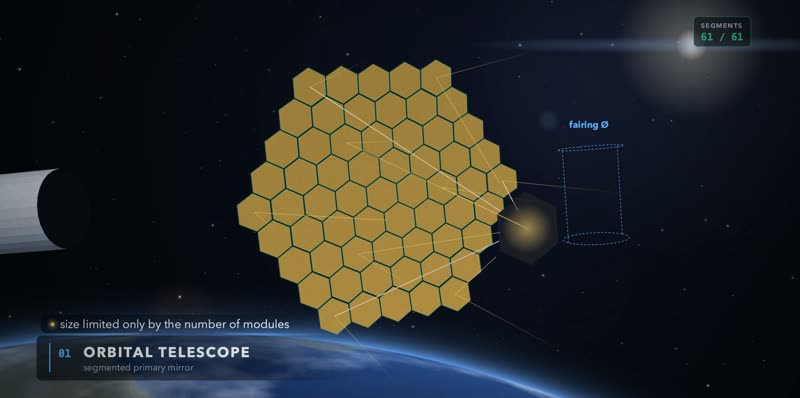
Telescope mirror
Segments leave their container and line up around a central seed, ring by ring. Mirror size is limited only by the number of modules, not by the fairing.
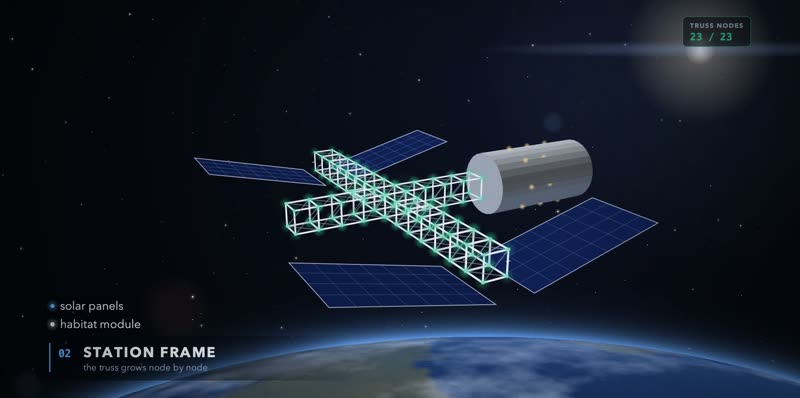
Station frame
Truss modules grow the frame node by node; solar panels and a habitat module dock to the finished structure.
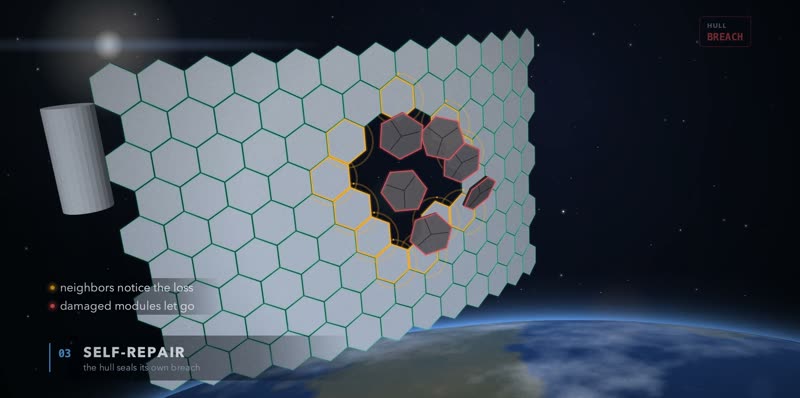
Self-repair
After a micrometeoroid strike, neighbors notice the loss, damaged modules let go, and spares seal the breach — damage is just another trap to escape.
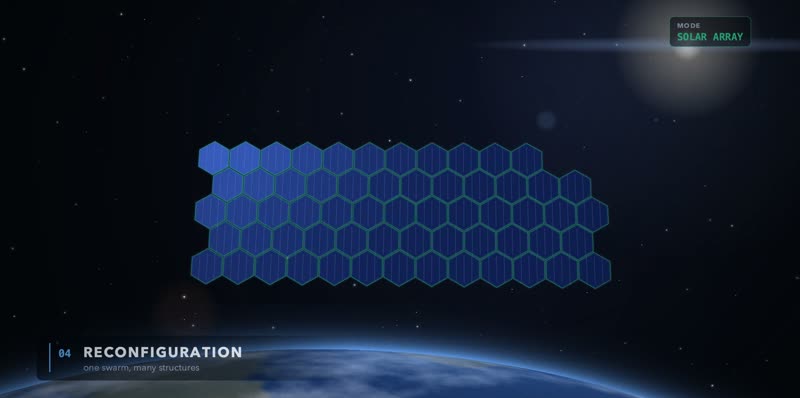
Reconfiguration
The same swarm is an antenna today and a solar array tomorrow: the structure changes shape on command, without returning to Earth.
Use-case scenes visualize the concept; they are not engineering simulations.
Reversible self-assembly on an air table
We want to prove on a tabletop that a swarm of identical modules — no motors and no central control — assembles into a target shape from random encounters, and fixes its own mistakes.
Motion from outside, decisions inside
The main question: can modules not only stick together, but also break free from a wrong configuration — a kinetic trap — while holding the shape within tolerance? If yes, the principle of reversible self-assembly is proven; the rest is engineering.
Motion from outside
External noise stirs the modules. A module has no motor: it only thinks and controls its locks.
No center
Each module knows only the neighbors it touches. Identical modules; a role such as the seed is set by firmware, not by hardware.
Reversibility in the lock
An electromagnet holds only while current flows. Cut the current — it lets go. The shape is set by a bonding rule, not by each module's path.
Play with the rules
The same model as in the video, running live in your browser. Pucks glide at constant speed; they change velocity only on impacts, latch/release, or an air jet. Click a locked puck to remove it and watch the swarm repair the arc. Click the empty table to give the pucks a puff of air.
Removed modules come back onto the table a few seconds later. Illustrative model of the stage-0 rules, not experimental data.
Four rules, decided by each module
Correct bonds lock in as a chain from the seed; wrong ones fall apart on a timer.
Seed
One module gets number 0 and is always locked.
Gradient
A module that locks next to number n gets n + 1 and passes it on.
Bonding rule
A lock holds only if the neighbor's number and the contact side match the target shape. The “position → allowed neighbor” table lives in firmware.
Uncertainty timer
After coupling, a module waits N seconds for confirmation from the seed. None? It cuts the current and returns to the noise — so wrong couplings and seedless clusters dissolve.
Tuning parameters: N, noise intensity, lock strength.
The puck module
A lightweight puck that only thinks and controls its locks: all energy goes to the controller and to holding bonds.
| Body | Puck Ø 5–7 cm, minimal mass, 3D-printed; must float on the air table |
| Controller | Inexpensive microcontroller with a few free pins |
| Locks | 3–4 electromagnets around the rim, each with its own transistor switch; hold only while powered |
| Contacts | A pair of spring-loaded pins at each docking point: detect touch, exchange ID and gradient number |
| Power | Small LiPo battery with charging circuit; nothing spent on motion |
| Indicator | RGB LED: free, coupled, locked, trapped |
| Marker | ArUco marker on the lid for the overhead camera |
2D weightlessness
Pucks float on an air cushion with almost no friction; external noise brings them together at random.
| Air table | Smooth perforated plate, blower underneath (e.g. an air-hockey table) |
| Bumper | Soft border, so pucks bounce without hard impacts |
| Noise | Adjustable: air jets at the edges or table vibration |
| Camera | Overhead, whole table in frame: tracking and shape accuracy |
Docking, in detail
Spring-loaded contacts register the touch. Modules exchange ID, gradient number and a checksum, retrying on error. If the rule matches, a magnet turns on — on one side of the pair only, since two powered magnets can repel (alternative: polarity via an H-bridge). Iteration 2: electropermanent magnets or a latch, so current is needed only to switch.
Measured by the overhead camera
Targets are starting hypotheses, to be refined after step 3.
Successful assembly
Runs where every module reaches its place within T ≤ 10 min
Shape accuracy
Deviation of each puck center from the target arc
Escaping traps
Wrong couplings that break free without intervention
Self-repair
Time to restore the shape after a module is removed — no longer than the original assembly
Autonomy
Module runtime on one charge — several runs
Step by step
Don't move to the next step until the previous one works reliably.
- RigAn empty puck of target mass floats freely without sticking.
- 2 modules by handLock engages, data passes over the contacts, lock releases on command.
- 2 modules in noiseThe right pair holds, the wrong pair separates.
- 6–10 modulesAn arc assembles from the seed and escapes traps.
- Self-repairRemove a module from the arc — the shape recovers within tolerance.
Assembling large structures in orbit
Antennas and mirrors built from modules launched loose — with no limit set by the size of the rocket fairing. Next step: a parts list and a budget for a pair of modules and the test rig.